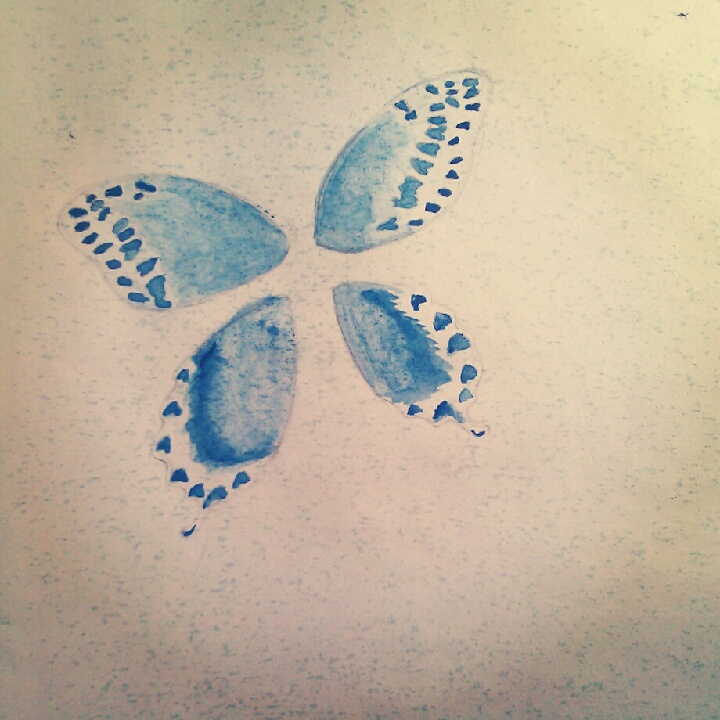
"All art is always created from a base of someone else’s work. There is no 'new.' No one invents art. You always have a base of someone you’re—I can’t think of any other word to use—you’re *copying* them even if you don’t remember it. It might be Picasso, it might be Michelangelo’s finger, it might be Da Vinci’s earlobe…but you’ll remember it. That’s the creative process: you look at things and you’re impressed by it, and your job then is to show it to others and say, 'I like this, look at this.' Or, 'I hate this, look at this.' That’s what the artistic
life is all about."
Ed Emberley
Showing posts with label advice. Show all posts
August 22, 2012
Wings & Words
Labels:
advice,
artists,
creative process,
inspiration,
paint,
poetry,
sketchbook,
watercolor
August 16, 2012
Ritual
{Chapter 2: Rituals of Preparation}
"It's vital to establish some rituals ... at the beginning of the creative process, when you are most at peril of turning back, chickening out, giving up, or going the wrong way."
"A painter I know can't do anything in her studio without propulsive music pounding out of the speakers. Turning it on turns on a switch inside her. The beat gets her into a groove. It's the metronome for her creative life....there is no one ideal condition for creativity. What works for one person is useless for another. The only criterion is this: Make it easy on yourself. Find a working environment where the prospect of wrestling with your muse doesn't scare you, doesn't shut you down. It should make you want to be there, and once you find it, stick with it. To get the creative habit, you need a working environment that's habit-forming."
"This, more than anything else, is what rituals of preparation give us: They arm us with confidence and self-reliance."
"When I walk into the white room I am alone, but I am alone with my:
bodyambitionideaspassionsneedsmemoriesgoalsprejudicesdistractionsfearsThese [are] at the heart of who I am. Whatever I'm going to create will be a reflection of how these have shaped my life, and how I've learned to channel my experiences into them.Distractions and fears [are] the habitual demons that invade the launch of every project."
"When you have selected the environment that works for you, developed the start-up ritual that impels you forward every day, faced down your fears, and put your distractions in their proper place, you have cleared the first hurdle. You have begun to prepare."
----------------
{Exercises}1 Where's your "Pencil"?
What is your pencil? What is the one tool that feeds your creativity and is so essential that without it you feel naked and unprepared?
2 Build up your tolerance for solitude
3 Face your fears
4 Give me one week without
Labels:
advice,
creative process,
reading,
the creative habit
August 14, 2012
White Room
This morning I picked up Twyla Tharp's The Creative Habit at the public library. I'm only through the first chapter and finding it encouraging and insightful. The core message is nothing new, it can be summed up to the classic "Genius is one percent inspiration and ninety-nine per cent perspiration"; however, it breaks the "perspiration" part down into pieces and then gives exercises to work through.
October 2, 2011
I Recommend You Learn to Cook
Carla Speed McNeil on self-publishing:
I moved my game to Dark Horse because I am one.
I’ve been a self-publisher for a long time. I highly recommend it. Think of it (as you learn to live on beans and ramen) as an apprenticeship in our business. When you self-publish, you learn to create your own work method. You have to learn what gets you out of bed and away from the game console, the whole season of Stargate from Netflix, the big pile of comics you haven’t read yet, the day job, the significant other, the messy mind that talks you out of working like an anorexic’s mind talks her out of eating. You go through a process that teaches you what can and should be put aside for later or brutally pruned off your life so that you can get your work done consistently. That is the absolute baseline. And you have to do it, because there are gonna be things that cannot be put aside. A family is basically another day job, one you can’t quit once you start. You may find yourself caring for sick parents, a sick spouse, or even sick you; learning how to get the work done in spite of the things you simply must take care of is where you start. I recommend you learn to cook. Beans get to look mighty ugly after a while. I learned to make port-wine reductions living in an efficiency apartment with no kitchen—just an electric skillet and a hot plate.
Labels:
advice,
creative process,
graphic novels,
illustration
July 4, 2011
The Most Important Thing
Nobody tells this to people who are beginners, I wish someone told me. All of us who do creative work, we get into it because we have good taste. But there is this gap. For the first couple years you make stuff, it’s just not that good. It’s trying to be good, it has potential, but it’s not. But your taste, the thing that got you into the game, is still killer. And your taste is why your work disappoints you. A lot of people never get past this phase, they quit. Most people I know who do interesting, creative work went through years of this. We know our work doesn’t have this special thing that we want it to have. We all go through this. And if you are just starting out or you are still in this phase, you gotta know its normal and the most important thing you can do is do a lot of work. Put yourself on a deadline so that every week you will finish one story. It is only by going through a volume of work that you will close that gap, and your work will be as good as your ambitions. And I took longer to figure out how to do this than anyone I’ve ever met. It’s gonna take awhile. It’s normal to take awhile. You’ve just gotta fight your way through.
Ira Glass (source)
Subscribe to:
Posts (Atom)

